
Common Issues in Chlorine-Sanitized Private Pools
Owning a private swimming pool comes with the joy of relaxation—but also the responsibility of proper care. If you’re using chlorine as your primary sanitizer, here are some common challenges you may encounter and what they mean:
Water Quality Issues
-
Cloudy or Milky Water
Often caused by poor filtration, high calcium levels, or unbalanced water chemistry. It may also indicate the need for shock treatment. -
Green Water
Typically a sign of algae growth due to low chlorine levels or poor circulation. -
Reddish or Rusty Water
Often caused by high levels of iron or manganese, usually from the water source. These can stain surfaces if not treated properly.
Bather Discomfort
-
Eye Irritation & Redness
Contrary to popular belief, this is usually due to imbalanced pH, not high chlorine. Ideal pH should be around 7.4–7.6. -
Chlorine Sensitivity or “Allergy”
Some swimmers may experience rashes or breathing discomfort. This can be a reaction to chloramines (a byproduct of chlorine mixing with body oils and sweat), not the chlorine itself.
Chlorination Challenges
-
Unstable Chlorine Levels
Exposure to sunlight without proper stabilizers (like cyanuric acid) can cause chlorine to dissipate quickly. Overuse of chlorine can also result in chloramine buildup. -
Strong Chlorine Smell
This indicates combined chlorine (chloramines), not effective free chlorine. Shock the pool to correct this.
Water Balance Problems
-
Unstable pH
Low pH causes corrosion, while high pH leads to scale buildup and reduced sanitizer effectiveness. -
Alkalinity Swings
Total alkalinity helps buffer pH. Too low, and your pH fluctuates; too high, and it becomes difficult to adjust pH.
Pool Surface Issues
-
Staining
Can be caused by metals, organic debris, or imbalanced chemistry. -
Scaling or Rough Surfaces
Usually the result of high pH or calcium hardness. Can lead to discomfort and surface damage over time.
Filtration Problems
-
Low Flow or Ineffective Cleaning
A dirty or undersized filter, clogged pump basket, or air leaks can all reduce circulation, leading to murky or unclean water. -
Frequent Backwashing or Cartridge Cleaning
May indicate poor water quality or heavy debris load. Consider reviewing your maintenance routine and water chemistry.
Staying on top of these common issues helps keep your pool water safe, clear, and inviting all season long. If you’re unsure about the source of a problem, a quick test of your pool water or consultation with a professional can save time and money.
Water Clarity Problems
SYMPTOM: Cloudy/milky Water. There are four possible causes : -
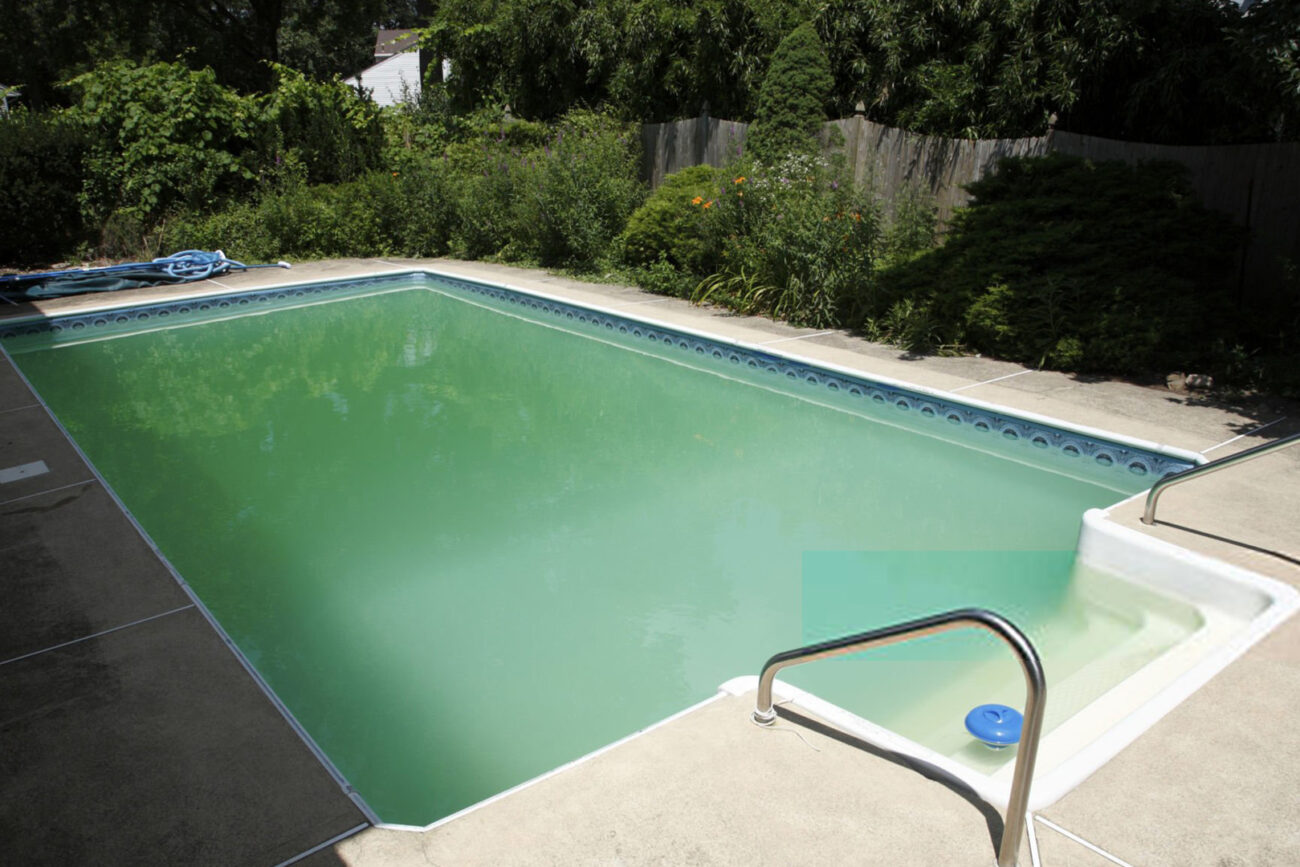
First possible cause:
- Fine suspended particles floating in the water can lead to a milky white discoloration. This will probably be due to a precipitation of dissolved hardness salts as result of high pH or high total alkalinity, or both. (Precipitation is a process where dissolved minerals become transformed into very small solid particles).
Remedy:
- Lower the pH or alkalinity using pH decrease. To correct pH, add pH reducer (dry acid) at a rate of 1kg per 100 cubic meters (10,000 liters) per day until correct reading is obtained.
- To correct alkalinity, the dose should be doubled. It is important to add the acid a little at a time and pre-dissolved at a dilution no stronger than 8:1. For example, if you’re preparing 9 liters of diluted solution, you would use 8 liters of water and 1 liter of acid.
Second possible cause:
- Build up of dirt and bather pollution due to insufficient chlorine or poor filtration
Remedy:
- Backwash filter, then shock your pool by adding chlorine such as TCCA – 90 to raise the chlorine to 10ppm.
- Add a water clarifier (if needed) to polish the water.
Third possible cause:
- The effectiveness of the chlorine has been reduced in pools using stabilized chlorine donors because the water is over-stabilized i.e. the levels of stabilizer (cyanuric acid) are too high. This prolongs the time it takes to kill organisms (bugs) which can proliferate and lead to haziness in the water.
Remedy:
- Replace some of the pool water by draining to waste (or carrying out an extra large backwash), then top up with fresh mains water. This will lower levels of stabilizer.
- Shock your Pool to 10ppm using the products recommended above.
Fourth possible cause:
- The filter is blocked or is ineffective
Remedy:
- Check sand and replace if necessary. Your dealer should be called in if you do not feel equal to the task.
- Sand particles can become coated with calcium in some circumstances, especially in hard water areas. If the filter is not blocked and seems all in order in all other respects, treat with a filter cleanser to sharpen the sand.
SYMPTOM: Cloudy/green Water
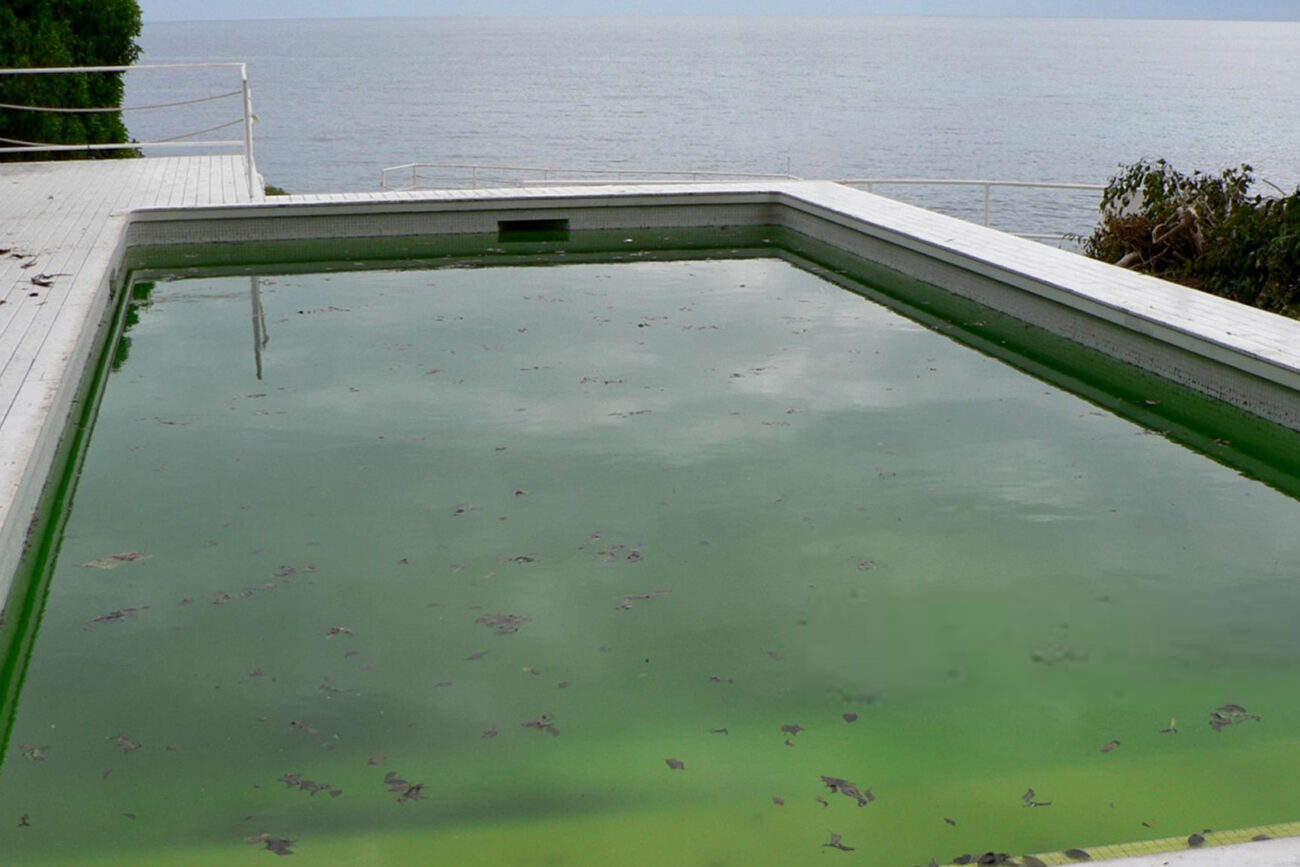
Probable cause:
- At some stage, chlorine levels have fallen, or chlorine has become ineffective, allowing algae to colonize the water.
Remedy:
- Shock dose with an de-stabilized chlorine such as calcium hypochlorite or sodium hypochlorite, or use an algaecide. Shock dosing usually produces the fastest results. For greenish discolorations (where the water is no more than tinted green), shock you pool to 10ppm. For more serious problems, where the water is pea-soup green and the bottom is invisible, shock dose up to around 25ppm. This will kill the algae.
- Brush off any algae that may remain on pool surfaces. Look for colonies behind step ladders and around underwater lighting.
- Backwash the filter 24 hours later to remove dead algae from the top of the filter media.
- Any remaining haziness in the water should be removed by using a water clarifier. The cationic clarifiers are best in this situation.
- Thereafter maintain chlorine at around 3ppm to prevent a recurrence.
- If the pool is particularly susceptible to algae, consider regular use of an algicide or a chlorine with added algicide.
SYMPTOM: Rust red Water
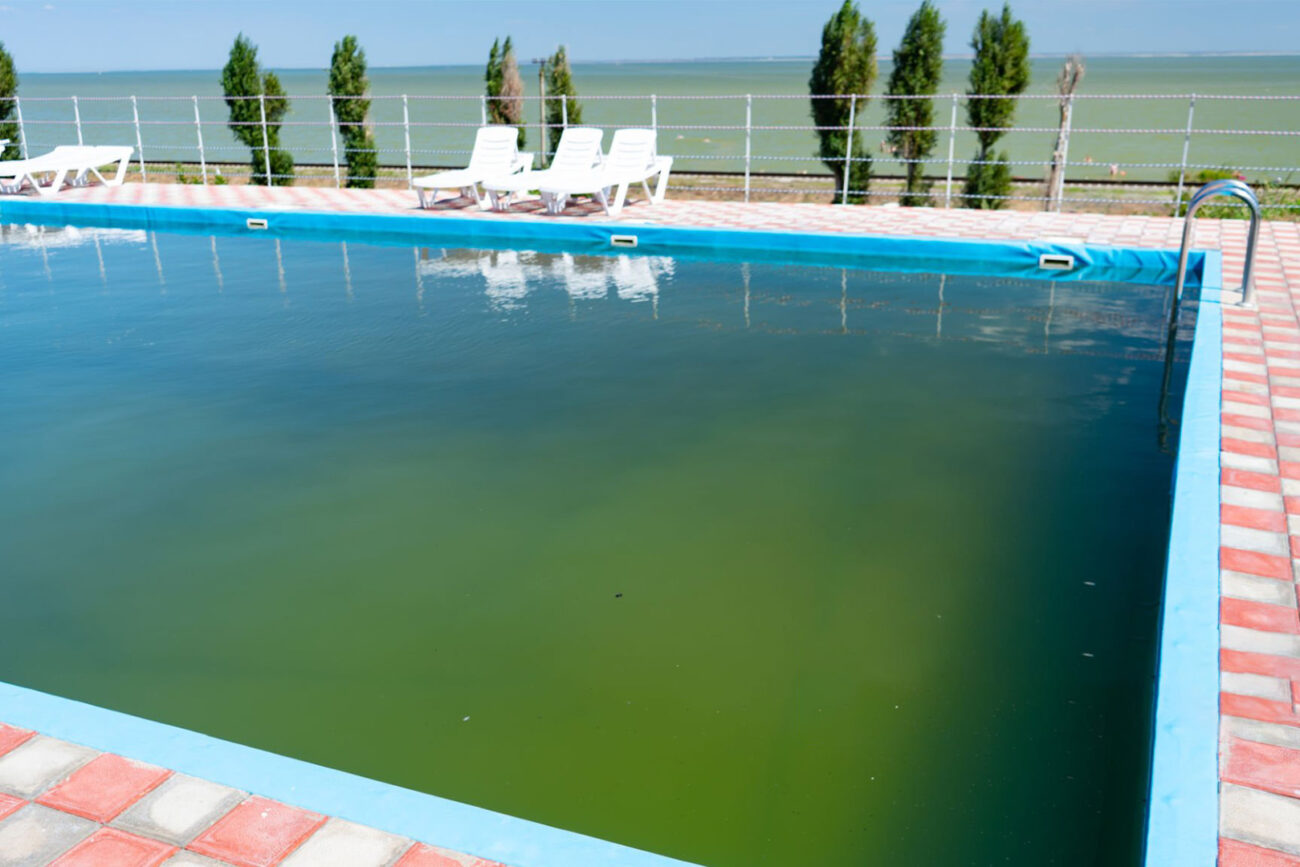
Probable cause:
- Steel or ferrous metal fittings in the circulation system e.g. pipes are being corroded by low pH. A shock dose of chlorine will then oxidize the ferrous particles creating rust. This can often happen after re-opening a pool.
Remedy:
- It is necessary to act very quickly to prevent consequential damage such as staining of the liner, if fitted. Contact your pool installer or pool dealer to see if it is safe to drain down and replace the water all in one go, or whether this should be done by progressive dilution.
- Remove any rust staining from the pool surfaces with a good tile and liner cleaner.
- Replace the ferrous metal fittings using pvc or copper.
- Ensure the fresh water is properly balanced i.e. that pH and total alkalinity are within recommended parameters.
Bather Discomfort Problems
SYMPTOM: Stinging eyes, sore throat and skin irritation. There are three possible causes :-
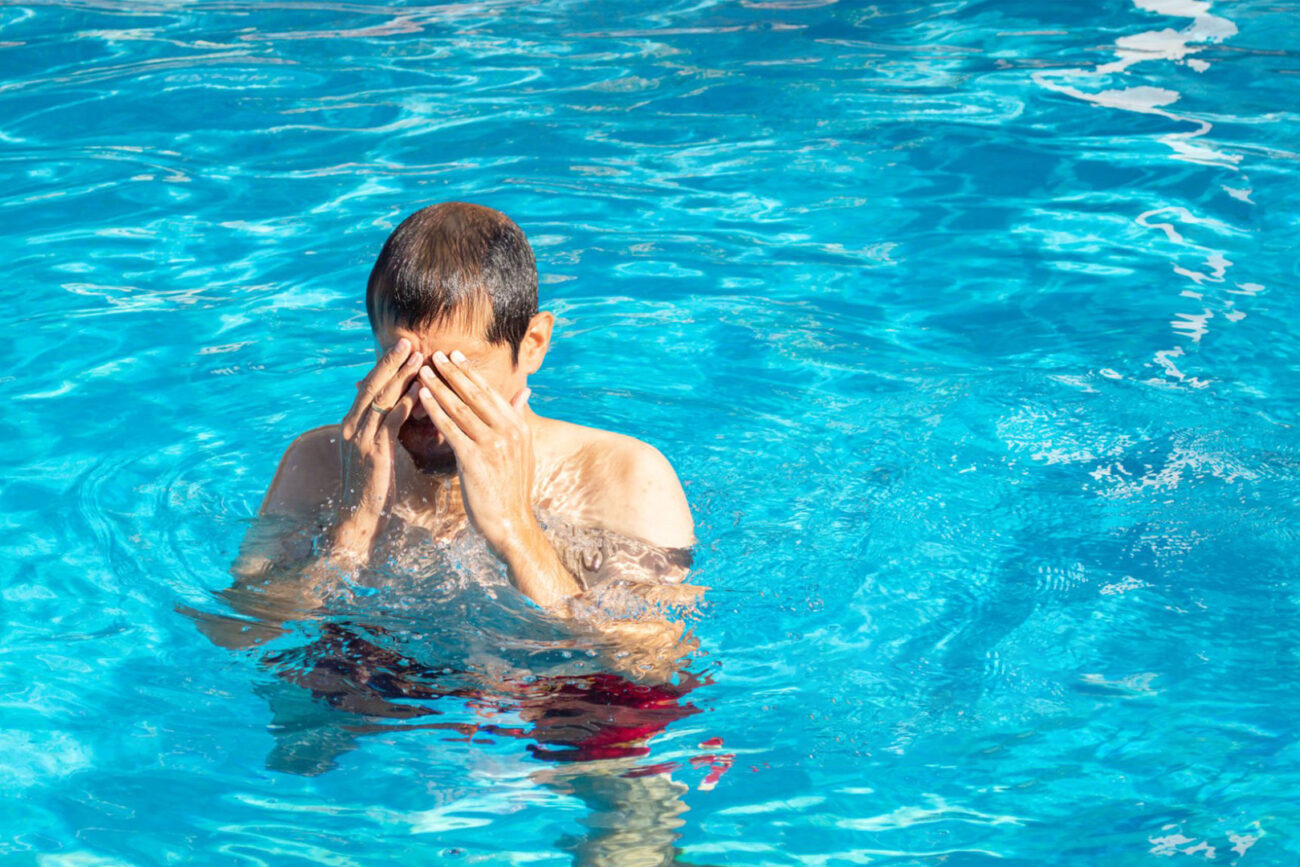
First possible cause:
- This could well be a pH problem – the water could be too acidic or too alkaline. The pH of the human eye is around 7.4-7.5 – anything higher or lower will irritate. The problem would be made worse if the pH is out to the extent that it changes the species of chlorine (see pH explained)
Remedy:
-
- Correct the pH. To lower the pH, add dry acid at a rate of 1kg per 100 cubic metres (1,00,000 liters) per day until correct reading is obtained. To raise pH, dose at the same rate not with dry acid, but with soda ash.
(if you are not sure and require some clarity on this please contact Pronto Pools for more information)
Second possible cause:
- High combined chlorine. Chloramines are known to be an irritant. Note carefully the results you get on your test kit. Also, if you get an unpleasant chlorine smell, its odds on that the problem is due to high chloramines.
Remedy:
- Break the chloramines down by shocking the pool with up to 10ppm free chlorine.
- Aim to allow no more than one third of the total chlorine to be in the form of combined chlorine.
Third possible cause:
- Some detergents used for cleaning pool sides and removing scum lines (tide-marks) are incompatible with chlorine. This can unfortunately include many products sold specifically for this application. The resulting reactions in the water can lead to eye and skin irritation. Similar reactions can occur if soaps or shampoos get into the water, for instance if bathers jump in to rinse off.
Remedy:
- Shock dose your pool to react-out the detergents.
- Change to cleaners that are chlorine compatible or abandon their use and resort to a little elbow grease.
SYMPTOM: Blond or tinted hair turns green :-
Probable cause:
- High levels of copper in the pool. This can arise either because of over-use of copper based algaecides, or because the pH of the pool water has been allowed to drop to a point at which it starts to corrode the copper fittings in the heater.
Remedy:
- Correct the pH. To raise the pH, add soda ash at a rate of 1kg per 100 cubic meters (1,00,000 liters) per day until correct reading is obtained.
- Your pharmacist should be able to recommend a shampoo to remove the unwanted pigment.
SYMPTOM: Allergy to chlorine :-
Probable cause:
- The most important thing is to make sure that you really are suffering from a genuine allergy and not something else. The discomfort you feel could be due to other factors. For instance, it be due to the fact that the pH of the water is too low or too high. Alternatively it could be due to high levels of combined chlorine (chloramines) – chloramines are known to be irritants. Both these things are explained in more detail in ‘Stinging eyes, sore throat and skin irritation’ on this page). Test the water for pH and chloramines and correct as necessary.
Remedy:
- If you think you have a genuine allergy, then sadly the only remedy is to change to a non-chlorine sanitizer. Be warned that a number of these require to be dosed or shock dosed with chlorine. Consult your pool dealer for suitable alternatives.
Problems with Chlorine Levels
SYMPTOM: Chlorine has been added to the water, but there is no reading on the test kit :-
Probable cause:
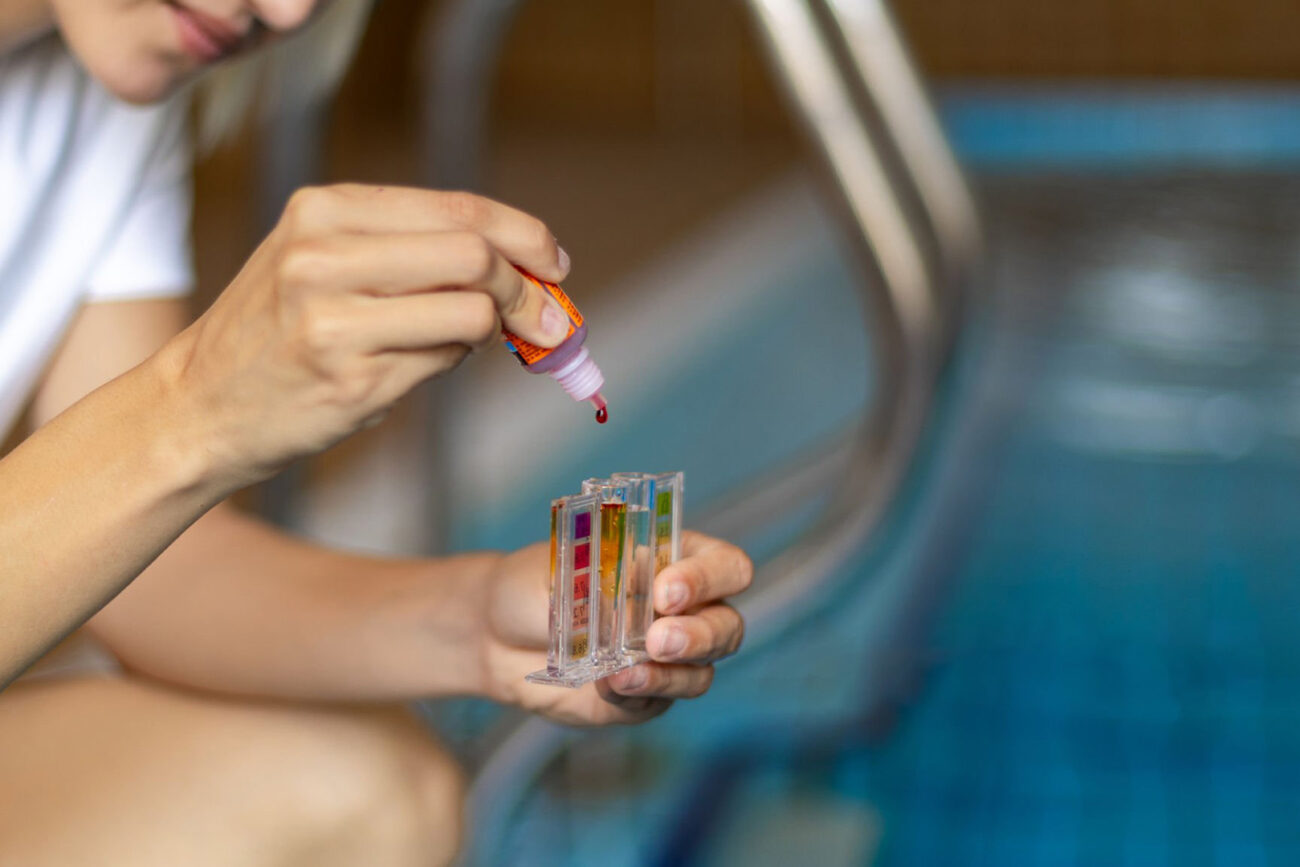
- The chlorine level in the pool is so high that it bleaches the coloring agent in the test tablet. To confirm the diagnosis, see if you can detect a smell of chlorine off the surface of the water, or repeat the pH test with only a droplet of pool water in the test tube and watch closely to see if there is a red discoloration before the bleaching occurs.
Remedy:
- Determine the approximate level of chlorine by diluting the sample of pool water with an equal quantity of natural or distilled water; multiply the answer by 2. If there is still no reading, repeat the process and multiply the answer by 4…and so on.
- If the actual chlorine reading is not too high (i.e. around 10ppm), suspend dosing and allow it to drop over a period of time.
- If the chlorine reading is significantly higher, or if you need to use the pool in the near future, add sodium thiosulphate to reduce the free chlorine.
WARNING The recommended dose rate is 0.5kg per 100 cu metres (1,00,000 liters). Apply this in several much smaller additions, testing after each dose. An overdose of thiosulphate can leave you with ‘negative chlorine’ i.e. a chlorine deficit for a considerable time.
SYMPTOM: The chlorine level is difficult to maintain. There are three possible causes :-
First Possible cause:
- In outdoor pools, the hypochlorous acid (free chlorine) is being decomposed by ultra violet from the sun’s rays.
Remedy:
- For pools using liquid chlorine (sodium hypochlorite) or calcium hypochlorite, add stabilizer (cyanuric acid) at a rate of 3kg per 100 cu meters (1,00,000 liters). This should be dosed directly into the pool, NOT pre-mixed with the chlorine.
- Alternatively, switch to a stabilized chlorine – dichlor granules or trichlor tablets.
Second Possible cause:
- High water temperature. The logic is simple. Bugs are more at home in warm water and breed more quickly. The greater number of bugs will create a higher chlorine demand.
- As a rough rule of thumb to bear in mind if there is a heat wave, if the pool water temperature goes above 27 degree Celsius, the chlorine demand will double for each increment of 12 degrees Celsius.
Remedy:
- The dose rate of chlorine must be increased proportionately. Keep a close check on chlorine levels in hot weather.
Third Possible cause:
- Because chlorine levels have not been high enough, there has been a build-up of pollutants, and therefore an increase in chlorine demand.
Remedy:
- Shock Dose the pool to around 10ppm free chlorine
Water Balance Problems
SYMPTOM: Tendency for the pH to remain low (below 7.2) :-
Likely cause:
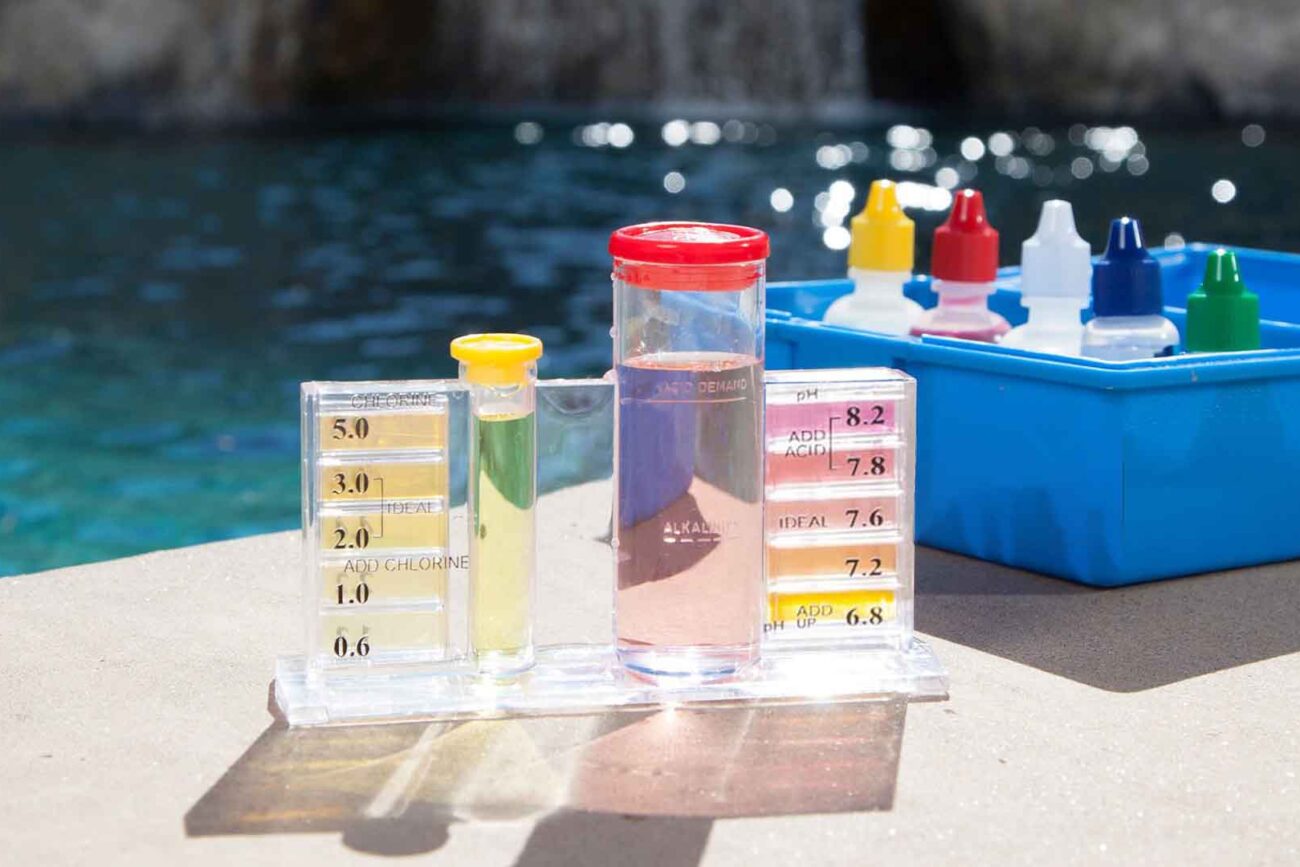
- This is usually due either to low pH of mains water (especially in soft water areas) or to the use of acidic chlorine donors, such as trichlor.
Remedy:
- Correct the pH. To raise the pH, add soda ash at a rate of 1kg per 100 cubic metres (1,00,000 lites ) per day until correct reading is obtained.
- Consider changing to a high pH chlorine source to help achieve a natural balance between the low pH of the water and the high pH of the chlorine donor. Dichlor is roughly pH neutral; calcium hypochlorite and sodium hypochlorite are high pH chlorine donors.
SYMPTOM: Tendency for the pH to be permanently high (above 7.6) :-
Likely cause:
- This is due to either (1) high pH of mains water (especially in hard water areas) or (2) to the use of alkaline chlorine donors such as calcium or sodium hypochlorite, or (3) to hardness salts being leached from new concrete or mosaic pools.
Remedy:
- The remedy is the same irrespective of which factor is at work here – correct the pH. To lower the pH, add dry acid at a rate of 1kg per 100 cubic metres (1,00,000 litres) per day until correct reading is obtained.
- For (1) and (2), consider changing to a low pH chlorine source to help achieve a natural balance between the high pH of the water and the low pH of the chlorine donor. Trichlor is the obvious chlorine donor to choose. For (3), the difficulties with new concrete pools will clear up of their own accord given sufficient time.
SYMPTOM: pH values are erratic and fluctuate :-
Likely cause:
- The reason will be that the total alkalinity will be too low to buffer the pH.
Remedy:
- Add sodium bicarbonate to ensure the total alkalinity remains above 100ppm. The dose rate is 3kg per 100 cu metres (1,00,000 litres) of pool water.
SYMPTOM: pH is locked :-
Likely cause:
- The water is over buffered due to high alkalinity. This is a not uncommon problem in hard water areas where the mains feed water has a high total alkalinity.
Remedy:
- Add dry acid to lower the total alkalinity to below 200ppm. The dose rate is 2kg per 100 cu metres (1,00,000 litres) of pool water. It is important to add the acid a little at a time and pre-dissolved at a dilution no stronger than 8:1.
SYMPTOM: Tendency for the alkalinity to be too low :-
Likely cause:
- The local feed water is low in bicarbonates so that whenever the pool is topped up from the mains, it dilutes the bicarbonates in the pool. This is a particular problem in soft water areas.
Remedy:
- Add sodium bicarbonate to raise the total alkalinity to around 100ppm. The dose rate is 3kg per 100 cu metres (1,00,000 litres) of pool water (this should raise the level by 20ppm per dose).
Problems with Pool Surface
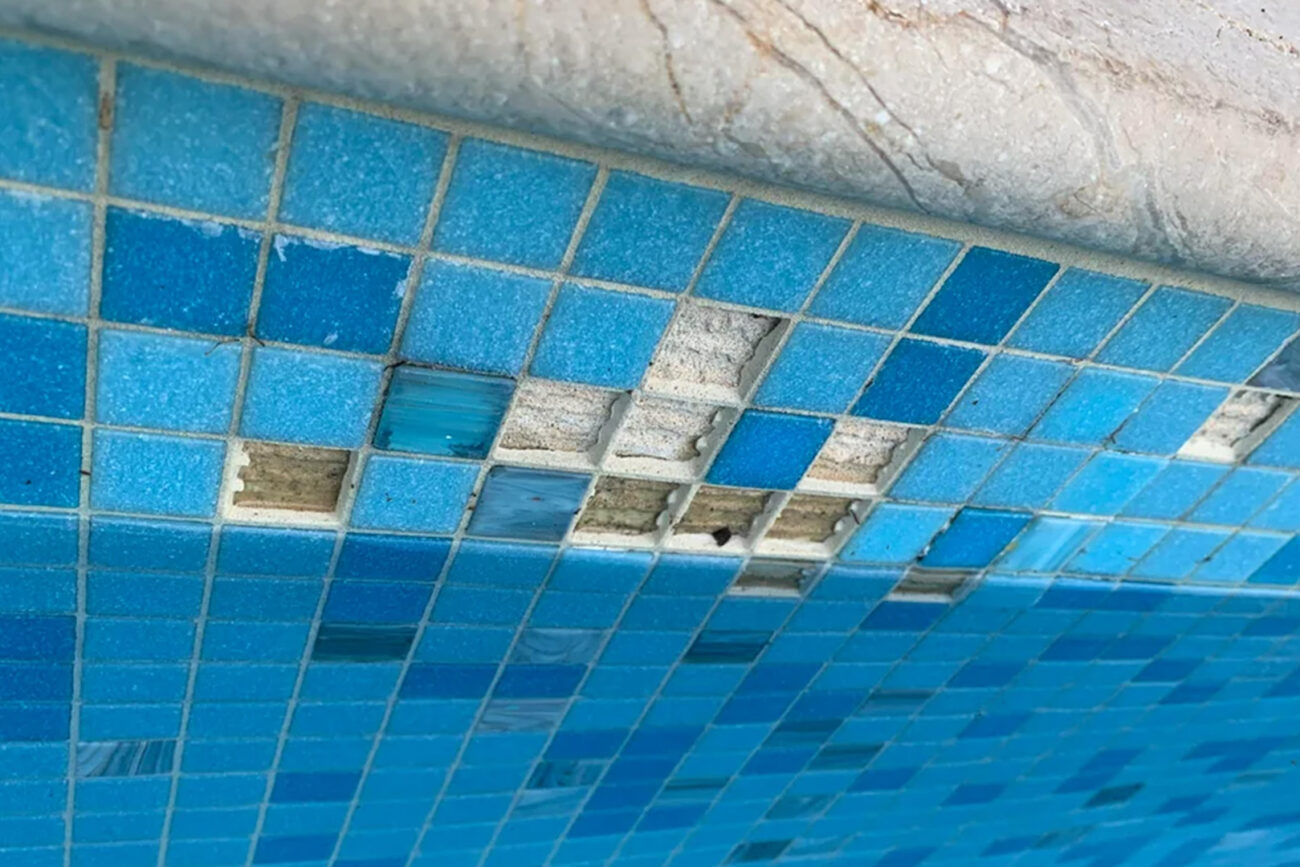
SYMPTOM: Loss of grouting in mosaic/tiled pools, or sharp edges around tiles :-
First Possible cause:
- In soft water areas, the grouting is being etched by the pool water. This is because there is insufficient calcium in the water. There is a tendency for water to form an equilibrium by searching for calcium – in this case from the grouting or plaster substrate.
Remedy:
- Regrout the pool and increase calcium levels in the water by adding calcium chloride flakes so as to achieve a minimum calcium hardness level of 250ppm. Alternatively, use calcium hypochlorite for shock dosing or for regular sanitization – calcium will be automatically added to the water in using this sanitizer.
Second Possible cause:
- High levels of sulphate in the water. You will need to get your pool center to test for sulphates to confirm this diagnosis. The sulphate level should not exceed 350ppm.
- High sulphates are caused by (a) high sulphates in the mains water (b) the frequent use of dry acid (sodium bisulphate) or (c) use of aluminium sulphate as a water clarifier.
Remedy:
- If you suspect factors (b) or (c), dilute with fresh water and switch to alternative methods of lowering the pH (e.g. using trichlor as the main pool sanitizer), or clarifying the water (a sulphate-free treatment). There is not much you can do about (a).
SYMPTOM: Pool surfaces feel rough and scaly :-
Likely cause:
- The balance between pH, total alkalinity and calcium hardness is incorrect, and the water is technically ‘scale forming’.
Remedy:
- Test for pH, total alkalinity and calcium hardness and bring them within recommended parameters. It is best to carry out a ‘Langelier’ water balance calculation (see water balance), or ask your pool center to do this for you.
SYMPTOM: Pool surfaces feel slippery :-
Likely cause:
- This is probably algae forming a colony on the pool surface due to insufficient chlorination at some stage, or to a ‘dead spot’ in the water circulation.
Remedy:
- Sweep the affected areas vigorously to remove as much algae as possible, then shock dose with an un stabilized chlorine (follow the procedure set out for killing algae). Prevent a recurrence by periodic use of an algicide
SYMPTOM: Tide mark on pool wall at water line :-
Likely cause:
- What you are seeing is a build up of greasy deposits such as cosmetics, sun cream or body fats.
Remedy:
- Clean with a tile and liner cleaner ensuring that it does not contain detergent compounds that could react with chlorine and cause bather discomfort.
Filtration Problems
SYMPTOM: Ineffective filtration in sand filters :-
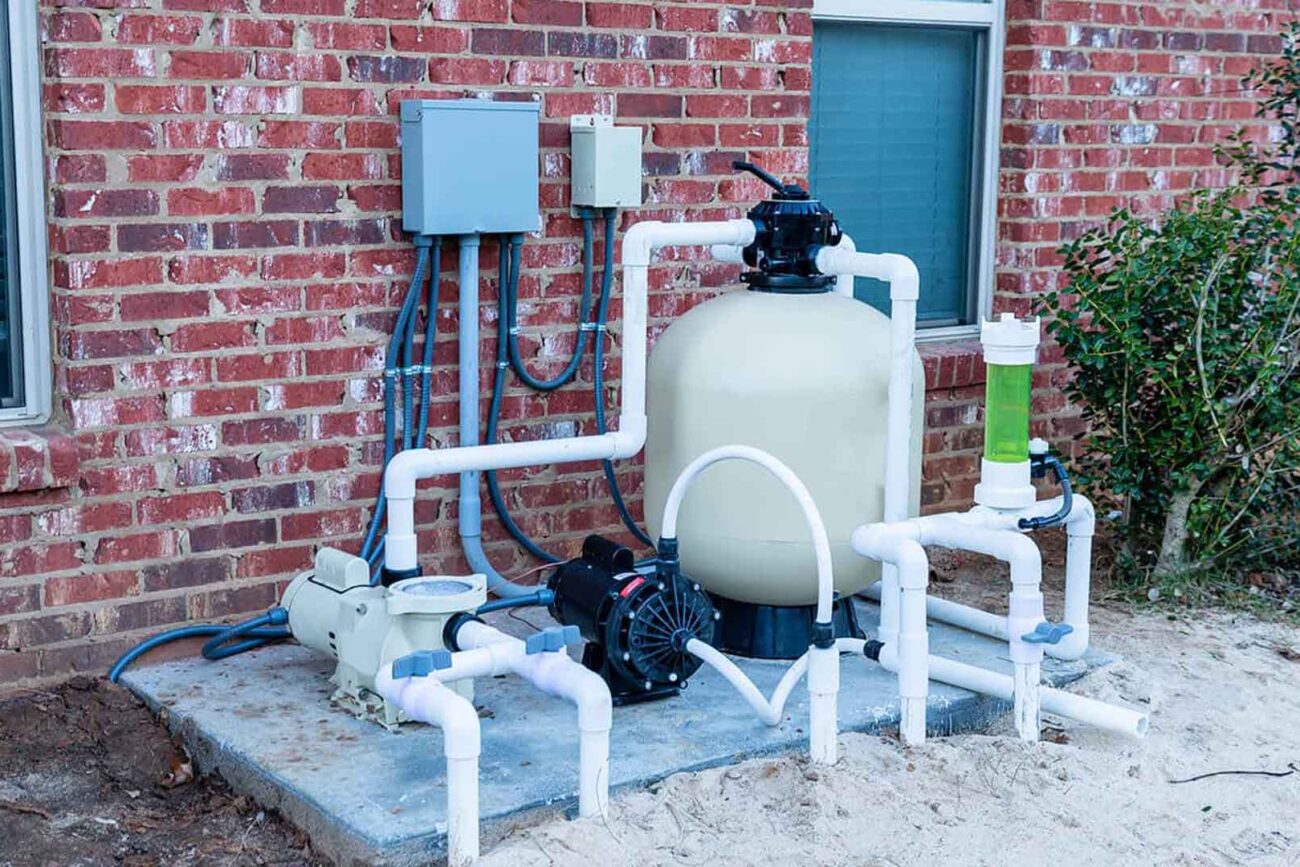
Possible cause:
- Either (a) sand has escaped from the filter leaving insufficient filter media to take out suspended particles, or (b) the filter is blocked by accumulated debris or (c) the sand particles are coated in calcium.
Remedy:
- For (a), its simply a matter of topping up the sand. If (b), the filter is blocked by debris, backwash. If the problem is persistent, and the sand particles are becoming coated with calcium (more likely in a hard water area), use a filter cleanser.
SYMPTOM: Ineffective filtration in sand filters :-
Possible cause:
- Either the cartridge is in poor condition, allowing particles to pass through it or the demands on it from debris in the water are too great for it to cope.
Remedy:
- Replacing the cartridge is the obvious remedy. If the problem is persistent, try using a filter aid or water clarifier. Failing this, the ultimate remedy is to install a sand filter.