
Chlorine - TCCA -90
Direction of Use
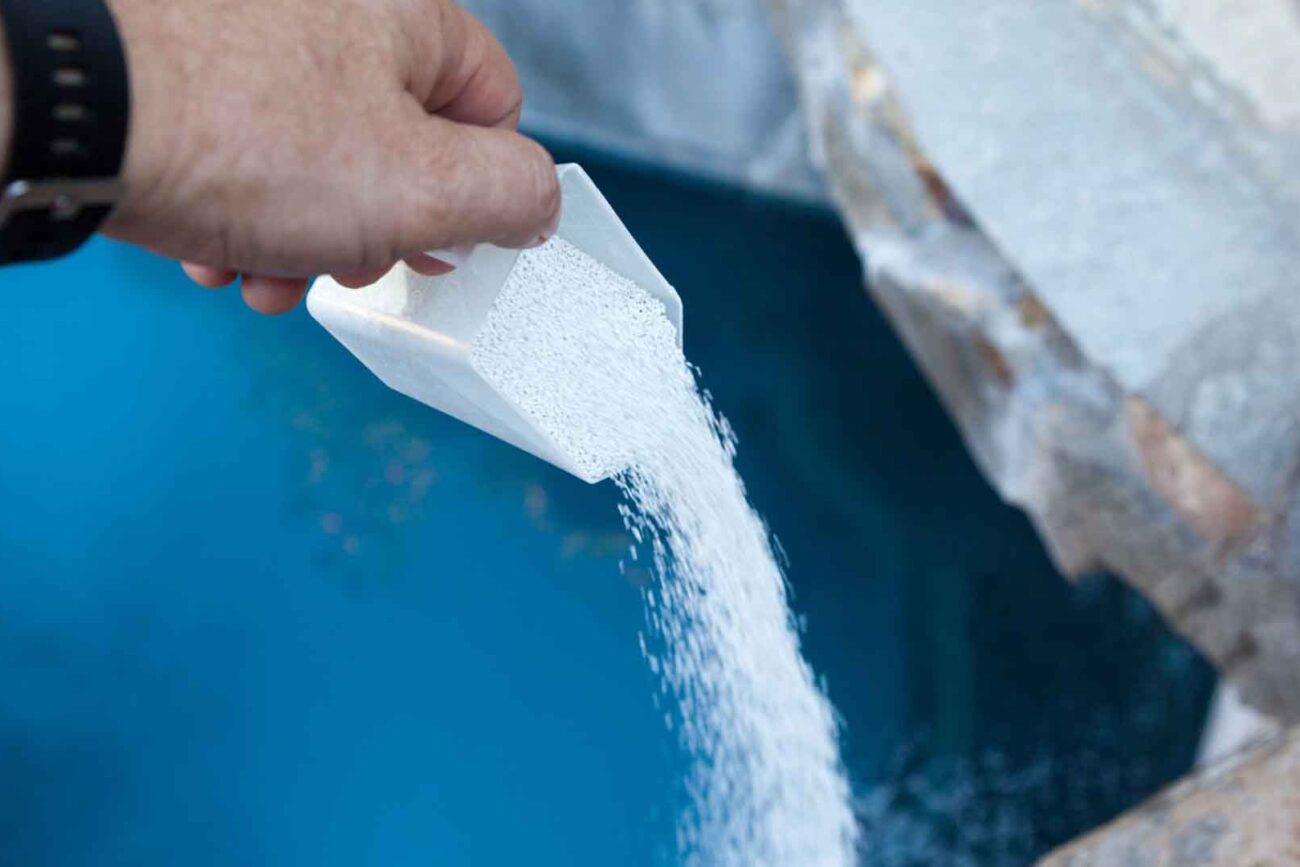
Disinfection of water in swimming pools
Initial treatment: Add 60 g per 10 m3 (10,000 liters) water for private pools and 150 g per 10m3 (10,000 liters) of water for commercial pools (at pH 7.2-7.6). Level of residual chlorine in water is 0,6 to 1,0 mg/l water. Swimming in the pool is not recommended for 1-2 days.
Maintenance: Add 50 g per 10 m3 (10,000 liters) water for private pools and 100 g per 10 m3 (10,000 liters) of water for commercial pools (at pH 7.2-7.6). Keep level of residuum chlorine in water at 0.2-0.5 mg/. Approximate time of reaction of the product is 7-10 days. Add directly in skimmer or overflow. Product dissolves very slow. Despite of the concrete usage scheme-for initial treatment or maintenance, keep the level of residual chlorine in the swimming pool between 0.2-0.5 mg/L.
Not for medicinal use. For industrial use only
For expert guidance on pool circulation and equipment, Pronto Pools is here to help!
Shock your Pool
Shocking is the process of adding a high dose of chlorine (usually doubling or tripling the amount of chlorine) to eliminate contaminants, algae, and bacteria. It’s especially important:
-
After heavy pool use
-
Following rainstorms
-
When water turns cloudy or green
-
After accidental contamination
Make it a habit to shock your pool every 1 to 2 weeks, or more frequently in hot weather or during peak usage.
For more information on how to shock a pool in 6 easy steps? Pronto Pools is here to assist with everything you need to keep your water balanced and beautiful.
Algaemove
Direction of Use
TEST AND BALANCE
Measure Basic Parameter Of Swimming Pool
- pH and chlorine
- Volume Of Pool
Provide data to the Technician and Balance the Parameter
HOW MUCH DOSE?
Initial dose of the chemical will be around 100 to 120ml per 10000 liters of water. However the exact dose depends on the contamination.
HOW TO DOSE
- Dilute 1 liter Algaemove in 10 liter of water
- Spread the solution in pool water
- Start pool filtration for 30 min for better mixing
CLEANING
- Brush the pool wall after adding Algaemove
- Vacuum the debris from the bottom very next day
MAINTANCE DOSE
- To maintain pool water quality dose
- Algaemove 25ml/10000ltr pool volume every week (Not Mandatory) Use at own Risk
Need help choosing the right chemicals or testing kits? Pronto Pools is here to assist with everything you need to keep your water balanced and beautiful.
pH Test Kit
Direction of Use
What is a pH Test Kit (for Pools)?
A pH test kit is a tool used to measure the acidity or alkalinity of pool water. It helps determine whether your water is too acidic (low pH), too alkaline (high pH), or balanced — which is critical for swimmer comfort, equipment protection, and chlorine effectiveness.
pH Scale Basics
-
The pH scale ranges from 0 to 14
-
7 = neutral
-
Below 7 = acidic
-
Above 7 = alkaline
-
-
For pools, the ideal pH is 7.2 to 7.6
What’s in a pH Test Kit?
A typical pool pH test kit contains:
-
Test vials or chambers – to hold water samples
-
Reagents – liquid drops or tablets that change color based on pH
-
Color chart – to compare the water sample color and determine pH level
-
(Sometimes) a chlorine test is included as well
How to Use It (Drop Test Kit Example)
-
Collect a water sample from your pool using the test vial.
-
Add a few drops of the pH reagent (usually red in color).
-
Shake or swirl gently.
-
Compare the color of the water to the pH color chart.
-
Adjust your pool chemicals based on the result.
Need help choosing the right chemicals or testing kits? Pronto Pools is here to assist with everything you need to keep your water balanced and beautiful.
Things to Know
Stabilized Chlorine
Stabilized chlorine is chlorine that already contains cyanuric acid (CYA) — a chemical stabilizer that protects chlorine from being broken down by sunlight. This makes it ideal for outdoor pools exposed to UV rays.
Types of Stabilized Chlorine
-
Trichloroisocyanuric Acid (Trichlor)
-
Usually found in tablets or sticks
-
Slow-dissolving, ideal for continuous chlorination through feeders or floaters
-
Contains about 90% available chlorine
-
Lowers pH slightly over time
-
-
Sodium Dichloroisocyanurate (Dichlor)
-
Available as granules
-
Fast-dissolving, perfect for small pools or spas
-
Contains about 55–60% available chlorine
-
Nearly pH-neutral
-
Need help choosing the right chemicals or testing kits? Pronto Pools is here to assist with everything you need to keep your water balanced and beautiful.
De - Stabilized Chlorine
Destabilized chlorine, also called unstabilized chlorine, is chlorine that does not contain cyanuric acid (CYA).
It is a powerful and fast-acting sanitizer that quickly kills bacteria and algae — but because it lacks UV protection, it breaks down rapidly when exposed to sunlight.
Common Types
-
Calcium Hypochlorite (Cal-Hypo)
-
Usually sold as a granular or tablet form
-
Contains 65–70% available chlorine
-
Raises pH and calcium hardness slightly
-
Commonly used for shock treatment
-
-
Sodium Hypochlorite (Liquid Chlorine)
-
Available as a liquid solution
-
Contains around 10–12% available chlorine
-
Acts quickly but needs frequent dosing
-
Does not add calcium or stabilizer
-
Need help choosing the right chemicals or testing kits? Pronto Pools is here to assist with everything you need to keep your water balanced and beautiful.
pH Increser
What is pH? (In Pool Water)
pH is a measure of how acidic or basic (alkaline) water is. It plays a critical role in maintaining safe, comfortable, and chemically balanced pool water.
pH Scale:
-
Ranges from 0 to 14
-
7.0 = Neutral
-
Below 7.0 = Acidic
-
Above 7.0 = Basic (Alkaline)
-
Ideal pH Range for Pool Water:
-
7.2 to 7.6
This is the range where:
-
Chlorine works effectively
-
Water feels comfortable for swimmers
-
Pool surfaces and equipment are protected
What Happens if pH Is Too Low (< 7.2)?
-
Water becomes acidic
-
Eye and skin irritation
-
Corrosion of metal parts and pool surfaces
-
Faster loss of chlorine
What Happens if pH Is Too High (> 7.6)?
-
Water becomes alkaline
-
Cloudy water
-
Reduced chlorine efficiency
-
Scale buildup on surfaces and pipes
Need help choosing the right chemicals or testing kits? Pronto Pools is here to assist with everything you need to keep your water balanced and beautiful.
pH Increser
A pH increaser is a chemical used to raise the pH level of pool water when it becomes too acidic (below 7.2). The most common type is sodium carbonate (soda ash), which increases pH without drastically affecting alkalinity.
Common Types
Sodium Carbonate (Soda Ash)
-
Most commonly used pH increaser
-
Raises pH quickly and effectively
-
Minimal effect on total alkalinity
Sodium Bicarbonate (Baking Soda)
-
Mainly raises alkalinity, but slightly increases pH
-
Used more for alkalinity adjustment than pH
Need help choosing the right chemicals or testing kits? Pronto Pools is here to assist with everything you need to keep your water balanced and beautiful.
pH Reducer
A pH reducer is a chemical used to lower the pH of pool water when it becomes too alkaline (above 7.6). High pH can cause cloudy water, scale buildup, and reduce the effectiveness of chlorine. The most common pH reducers are muriatic acid and sodium bisulfate.
Common Types
Muriatic Acid (Hydrochloric Acid)
-
Strong liquid acid
-
Fast-acting and widely used
-
Also lowers total alkalinity
Sodium Bisulfate (Dry Acid)
-
Safer to handle than muriatic acid
-
Available in granular form
-
Slightly slower to dissolve but effective
Need help choosing the right chemicals or testing kits? Pronto Pools is here to assist with everything you need to keep your water balanced and beautiful.
Chloramines
Chloramines are unwanted byproducts formed when free chlorine in pool water reacts with nitrogen-based contaminants like sweat, urine, body oils, and sunscreen. Instead of sanitizing the pool, chloramines reduce chlorine’s effectiveness and can cause strong odors and irritation.
How They Form
Free Chlorine (sanitizer) + Ammonia/Nitrogen (from swimmers) → Chloramines
Signs of Chloramines
-
Strong “chlorine” smell (actually chloramines, not chlorine)
-
Eye and skin irritation
-
Reduced chlorine effectiveness
-
Cloudy water
Need help choosing the right chemicals or testing kits? Pronto Pools is here to assist with everything you need to keep your water balanced and beautiful.
Langelier Saturation Index (LSI) Test
The Langelier Saturation Index (LSI) is a calculation used to predict whether pool water is corrosive, balanced, or scale-forming. It helps determine if your pool water is in chemical equilibrium, meaning it won’t damage surfaces or equipment.
What It Measures
The LSI is based on five key water parameters:
-
pH
-
Total Alkalinity (TA)
-
Calcium Hardness (CH)
-
Water Temperature
-
Total Dissolved Solids (TDS)
Need help choosing the right chemicals or testing kits? Pronto Pools is here to assist with everything you need to keep your water balanced and beautiful.
Sand in a Pool Filter — Explained
A sand filter is one of the most common types of filters used in swimming pools. It uses special filter sand to trap dirt, debris, and impurities from the pool water as it passes through.
What Is the Sand For?
-
The sand acts as a natural filter medium.
-
Pool water is pumped through the sand, which catches particles like:
-
Dirt
-
Dead algae
-
Insects
-
Oils and debris
-
-
Clean water flows back into the pool, leaving the dirt behind in the sand bed.
What Kind of Sand Is Used?
| Type | Description |
|---|---|
| Silica sand | Most common (Grade 20 silica, ~0.45–0.55 mm) |
| Glass media | Recycled glass, sharper edges, more efficient |
| Zeolite | Natural mineral, can remove ammonia, finer filtration |
Regular beach sand is not suitable — only special pool filter sand should be used.
How Often to Change Sand?
-
Every 3 to 5 years, depending on:
-
Pool usage
-
Water quality
-
How often you backwash
-
How Sand Works in the Filter:
-
Water enters the top of the filter tank.
-
It flows down through the sand bed.
-
Dirt and particles get trapped in the sand.
-
Clean water exits from the bottom and returns to the pool.
Backwashing the Filter
-
Over time, sand gets clogged with debris.
-
Use the backwash setting to reverse the flow, flushing out trapped dirt.
-
Should be done once pressure increases (~8–10 psi over clean baseline) or once a week during peak season.
Signs You May Have a Problem:
-
Sand returning to the pool → possibly a cracked lateral or standpipe
-
Dirty water even after filtration → sand may be worn out or channeled
-
Slow water flow / high pressure → time to backwash or replace sand
In Short
Sand in a filter is the key component that physically traps debris in pool water. When maintained properly (through backwashing and periodic replacement), it keeps your pool clean, safe, and clear
Need help choosing the right chemicals or testing kits? Pronto Pools is here to assist with everything you need to keep your water balanced and beautiful.